“A new wave of scientific studies shows just how much bleisure and workations have taken off in Germany. According to these studies, by 2025 67 per cent of business travellers will have gone on such a trip, according to a survey by the BZT and GCB in collaboration with the Blend_it! initiative. According to the Bleisure & Workation Monitor Germany, just over a fifth have had workation experiences.” Sylvie Konzack
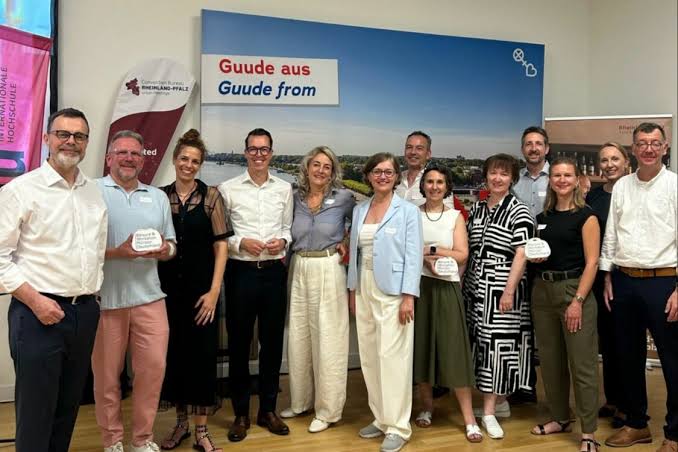
“This is my very first time in Mainz and I’m definitely going to add a few days off to my next visit,” said Andreas Zimmer, visibly impressed by the view of the Rhine skyline outside the conference venue, as he began his presentation of the results. This was music to the ears of Katja Mailahn and her team at MainzPlus. For years now, the city has been working with the state of Rhineland-Palatinate to promote ‘bleisure’ breaks in the region. In 2023, Rhineland-Palatinate – a pioneer in this field – even organised its own themed year and developed, amongst other things, the 20 per cent hotel discount offer “Stay a little bit longer”.
“Bleisure travel and workations have fundamentally changed the way we need to think about business travel,” Katja Mailahn told her tourism colleagues from across Germany. This involves making less of a distinction between business and leisure travel at destination level and collaborating more closely in this area. She is convinced: “We must no longer simply offer business travellers good infrastructure, but genuine experiences. That is why we should all work towards developing bleisure and workations from an additional offering into a central component of planning and service provision.”
The Bleisure & Workation Monitor 2026 demonstrates just how in demand such offerings are and will become; it provides, for the very first time, a comprehensive market overview of both the demand and supply sides of these two new forms of work travel. The report was compiled by Professors Peter Neumann, Sven Pastowski and Claudia Strassburger from IU International University, together with Dr Andreas Zimmer. As a research team, they surveyed over 1,000 business travellers and around 300 tourism providers, presenting their findings in Mainz in June.
According to the findings, 44 per cent of all German business travellers already extend their business trips – primarily following a business meeting or conference/event, and for an average of two nights. 81 per cent of bleisure trips take place in Germany, with destinations and offers being found mainly via online search engines, personal recommendations and the destination’s website.

When asked about their reasons for taking a bleisure trip, business travellers primarily cite an attractive destination, cost savings and visiting family. The research team presented various typologies for bleisure travellers in Mainz and emphasised the need for providers to cater to these different motivations. The potential remains high: a substantial 59 per cent are planning a bleisure trip in the next twelve months. And of those who have already been on a bleisure trip, 64 per cent would return. Bleisure travellers are therefore significantly more likely than business travellers in general to return to the destination of their business trip.
In average 3 nights bleisure
The Bavarian Centre for Tourism (BZT) has also recently carried out a representative survey on this topic for the first time, in cooperation with the Blend_it! initiative of the GCB German Convention Bureau e.V. (GCB) and the German Travel Management Association (VDR), involving 3,000 German business travellers aged between 18 and 74. According to this survey – which included even more younger participants than the Bleisure & Workation Monitor – as many as two-thirds of German business travellers had already combined a business trip with a private stay last year. This applies particularly to those aged up to 40 (over 70 per cent in their age groups) and those aged up to 49, with a share of 61 per cent. Two-thirds were men, 79 per cent were employees, and most held middle management positions.
One in two – and thus the majority – were on a MICE trip (MICE: Meetings, Incentives, Conventions, Exhibitions) – and two-thirds of them travelled alone. Domestic destinations were the most popular: 38 per cent travelled within Germany, primarily to Berlin, Hamburg and Munich. Trips to Spain, Italy, France and the USA followed, each accounting for less than 9 per cent.
The private part of the bleisure stay usually takes place directly at the business travel destination. In 2025, 61 per cent stayed at their accommodation, whilst a further 36 per cent explored the surrounding area. Changing accommodation was equally rare, with just under two-thirds staying in the same place. Two in three chose a hotel.
On average, the business part of the trip lasted 4.3 nights and the leisure part an additional 3.1 nights on average.
For each trip analysed, average total expenditure amounted to around 1,642 euros, of which approximately 616 euros were spent on the leisure part, with the majority of this – around 276 euros – going on the hotel. On average, around 115 euros is spent on restaurants and dining, followed by shopping expenditure, with an average of just under 107 euros.
Unsurprisingly, most people cite ‘rest and relaxation’, ‘a break from everyday life’ and ‘discovering new places’ as their reasons for extending a bleisure trip. The opportunity to visit family and/or friends, as well as the chance to make more efficient use of travel time or costs, also play an important role. In general, respondents felt that bleisure significantly or very significantly enhances an employer’s appeal (51 per cent). However, when asked, they considered flexible working time arrangements (66 per cent) and the option of working from home or remotely (61 per cent).
76 per cent of business travellers with bleisure experience plan to take a similar trip in 2026. At the same time, there is also growing interest among those who have not yet experienced bleisure. “This offers destinations new opportunities to broaden their guest base, both with new travellers and with repeat visitors,” emphasise the study’s authors. This is because 38 per cent of bleisure travellers state that they are (very) likely to return to the destination of their bleisure trip on a private visit. This figure is significantly higher than among those who have not previously engaged in bleisure travel – where the figure stands at just 13 per cent.
For workations by the coast and in the countryside
In its report, IU International University also examined the phenomenon of ‘workations’. According to the findings, around a good fifth (22 per cent) of those surveyed have already experienced a workation. On average, their workation trips last around six days, with searches primarily carried out via company-owned channels and online search engines.
The focus is primarily on destinations that offer a high quality of stay and good digital infrastructure – and, when it comes to workations, these do not primarily include major cities. Most (46 per cent) have so far been drawn to coastal regions, just over two-thirds to major cities and 30 per cent to rural areas. “Rural regions in particular, with a high quality of life, attractive natural surroundings and leisure activities, and good transport links, offer conditions that are especially appealing to bleisure and workation guests,” emphasises the research team. With workation, the main motivations differ from those of bleisure: quality of life, work-life balance and modern ways of working.
The Mainz Theses were drawn up
A key finding emerging from all the results is: “In many places, demand for bleisure travel and workations is growing faster than the corresponding supply,” says Peter Neumann. This is because 77 per cent of the providers surveyed do not yet have any specific bleisure offerings.
To enable faster action in this area, the research team has drawn up six “Mainz Theses” based on all the findings, outlining the potential and necessary areas for action. They are as follows:
1. The market is larger than anticipated – and the demand is already there.
2. Bleisure travel and workations also work outside major cities.
3. Most destinations are not yet exploiting their potential.
4. The gap in supply can often be closed using simple measures.
5. Destination management organisations are needed – but rarely act as drivers.
6. Bleisure travel and workations are becoming tools for companies to recruit and retain skilled staff.
The last point in particular means that employers need to develop significantly more in-house guidelines for bleisure and workations. Furthermore, academia and industry associations should ensure there are more training and further education opportunities for travel managers and tourism professionals. With this level of professionalism in place, destinations can in turn make their offerings more visible and create more connections and booking options throughout the entire journey, emphasises, amongst others, Hiskia Wiesner, Head of the Leipzig Convention Bureau.
Jens Ihsen, Managing Director of Düsseldorf Tourismus GmbH, says: “For conference participants, for example, we offer the Düsseldorf Card Plus with deals in other cities in North Rhine-Westphalia. It’s very popular.” And Veit Lawrenz, Head of Business Tourism at Tourismus NRW, is already dreaming that bleisure travellers will be so enthusiastic that they’ll spend their next workation – or even their next holiday – not on the coast or in the mountains, but right in the heart of North Rhine-Westphalia.
Sylvie Konzack …
 … is delighted with the wealth of new scientific data, which sheds more light on demand and needs on all sides. She hopes that employers and tourism providers will now work together even more closely.
Looking for venues and locations for your bleisure activities? www.micegermany.de will do everything for you!